Thursday, 16 April 2026

A new global carbon trading market could be held hostage by speculators

Habitat protection in the tropics needs generous and reliable funding. Kriangsak Unsorn/Shutterstock
Emre Tarim, Lancaster University

Our planet’s future hangs in the balance due to the unabated greenhouse gas emissions from burning fossil fuels. Treating these emissions as something that can be owned and exchanged in a market has been touted as a solution since the early 1990s, when UN negotiations to agree a limit to global heating began. At the latest round of talks in Azerbaijan, countries finally agreed rules for a global carbon credit market.

I study the world’s current largest scheme: the European Union’s Emissions Trading System (ETS). The ETS, like any other market, is plagued by price speculation and fraud. If this template is replicated on a global scale it will simply waste precious time that could be used to arrest and reverse greenhouse emissions.

The EU ETS is not the same as the UN carbon credit market. We still do not know what mechanisms the latter will use to generate a price on carbon. However, as both have their origins in the Kyoto protocol of 1997, the first global agreement to limit climate change which was replaced by the Paris accords in 2021, we can expect the UN carbon credit market to at least resemble the EU ETS.

That is, a cap-and-trade market in which regulators cap overall emissions and allow polluters to own and trade the greenhouse gases that exceed this limit. The UN carbon credit market will probably have a different cap for each member country. It is likely to depend on national emission reduction pledges.

Allowing market participants to put a price on emissions this way can incentivise more efficient power plants, for example. Those who can make such changes to cut their emissions below the cap can sell their surplus credit to those who cannot. The regulator gradually lowers the cap and the financial incentive is expected to rein in emissions and their harmful effects.

What the ETS can teach the world

The EU ETS, like many of its counterparts, is designed like a financial market. You do not need to manage a factory to be in the EU ETS, being a hedge fund manager or on the carbon trading desk of an investment bank will do. An effective response to climate change must consider the effects of these players on the market price of carbon overall.

Participation by these financial speculators is rife in the EU ETS, and estimated to make up most of the market’s multi-billion dollar trading activity. One finance industry insider described the EU ETS as a place for “wonderful (price) volatility”, led by speculators who buy and sell carbon credits in anticipation of their price changing.

A smoky industrial scene.
Industrial operators have managed to game the EU’s carbon market. BZ Travel/Shutterstock

Volatility in a global market would hurt developing countries the most, who otherwise stand to be this market’s principle beneficiaries. For example, selling carbon credits could finance the protection of relatively unexploited land and forests, or renewable energy projects that not only cut emissions but also guarantee energy and dignity to the most vulnerable. Carbon price crashes could fatally undermine the financing of such projects.

Speculators commonly do two things: guess what the price of carbon will be by analysing past prices (akin to astrology according to some economists) and make up and act on stories of the near future that will have some bearing on the carbon price.

It is not just financial speculators who can induce price volatility. Dishonest market participants benefit from regulatory loopholes and cause price crashes too. One loophole concerned the EU’s willingness to accept carbon credits under the Kyoto protocol that were derived from single emission reduction projects anywhere in the world.

This encouraged some industrial participants to needlessly emit greenhouse gases which are cheaper to eliminate, like HCFC-22/-23, and turn their subsequent emission reductions into credits which are measured in equivalent C0₂, a much more expensive gas to eliminate.

This was a clear case of carry trade (buy low, sell high), a staple of financial markets that forced down the price of carbon in the EU ETS and undermined the idea of capping and trading away carbon that is supposed to become more and more expensive to emit. Kudos to the EU for closing these regulatory loopholes, albeit with a delay of almost ten years.

Even when functional, existing cap-and-trade markets have a dubious record of cutting emissions. The ETS was revealed to have reduced total emissions in the EU by less than 2% a year in a 2021 study.

Yet, the EU has also been a global champion of cutting emissions since the start of the UN climate negotiations. This shows that taxes and green policies, such as renewable energy subsidies and sustainable investment funds, which the EU has, work.

We will have to wait and see how a global carbon credit market for countries and companies alike deals with the issues that the EU ETS has experienced.

The closer this new global carbon credit market resembles such a market, with its speculator storytellers and astrologers, the bigger the price chaos – and the more fraught a global green transition will be.


Imagine weekly climate newsletter

Don’t have time to read about climate change as much as you’d like?
Get our award-winning weekly roundup in your inbox instead. Every Wednesday, The Conversation’s environment editor writes Imagine, a short email that goes a little deeper into just one climate issue. Join the 40,000+ readers who’ve subscribed so far.


Emre Tarim, Lecturer in Behavioural Sciences, Lancaster University

This article is republished from The Conversation under a Creative Commons license. Read the original article.

Finansal Değerlemeler, Piyasa belirsizlikleri ve Pazarlama Dinamikleri

Amerikan borsalarını antropolojik açıdan inceleyen kitabında Arjun Appadurai analistler için finans piyasalarında 'Tanrı'nın işini yapanlar' diye bahseder. Nicel finans ve muhasebe literatürü incelendiğinde aslında bunun çok da abartı bir tasvir olmadığı görülebilir. Analistler hem pratik hem teorik açıdan evrenselleşmiş değerleme araçları ve yazdıkları hikayelerle şirketlerin piyasa değerleri üzerinde önemli etkilere sahipler. 2000'li yılların başında, belki de bugün Jeff Bezos'un dünyanın en zengin iş insanlarından biri olmasına katkıda bulunan Amazon değerleme savaşları analist şirket anlatılarının değerlemeleri ve piyasayı nasıl sürükleyebileceğini gösterdi. İronik olarak gene aynı dönemde bu tip anlatıların finansal değerleme sanatı ve biliminin en gelişmiş teknik taraflarını nasıl geri plana atıp Dot-com balonuna katkıda bulunduğu not edilir. Pandemi döneminde finans piyasalarında yaşanan görülmemiş piyasa değerlemelerinin analistlerin piyasa üzerinde hala güçlü etkilere sahip olduğuna yorulabilir. Bu vakalar ve anekdotlar dışında nicel finans ve muhasebe literatürü dünyanın belli başlı finans merkezlerinde çalışan analistlerin finansal değerleri tahmin yeteneği konusunda pek de iç açıcı olmayan sonuçlara varmaktalar. 
Örneğin literatürdeki birçok çalışmaya baktığımızda analistlerin finansal değerleme sonucu vardıkları şirket hedef fiyatlarının yarısından fazlasının ya da yarısına yakınının piyasada tutmadığı görülür. Diğer bir deyişle analistlerin birçok meşakkatli süreçten sonra buldukları hedef fiyatlarının tutma ihtimali piyasa dinamikleri karşısında yazı tura atmaktan daha iyi değil. Ayrıca nicel literatür, analistlerin şirket kazanç tahminleri ve hedef fiyat tahminlerinde sürü davranışı ve aşırı iyimserlik belirtileri görmekte ve bu ve buna benzer tahmin hatalarını analistlerin kariyer kaygılarına ve aracı kuruluş, yatırımcı kuruluş ve değerlenen şirket ilişkilerine (örn. pazarlama ve komisyon gelir kaygıları, kurumsal finans hizmetleri ve pazarlama ilişkileri ve gelir kaygıları vb.) bağlamakta. 

Peki tüm bu bilimsel bulgulara rağmen analistler hala neden dünya finans piyasalarının vazgeçilmez parçalarından biri? Bu sorunun cevabını nitel araştırmalarda buluyoruz. Küresel finans merkezlerindeki kurumsal yatırımcılarla ve şirket yöneticileriyle yapılan mülakat ve anket çalışmalarında analistlerin yarattığı değerin yaptıkları nicel tahminlerinden çok derinlemesine ve niteliksel şirket, sektör, piyasa ve ekonomi analizlerinde olduğu belirtiliyor. Kurumsal yatırımcıların ve şirket yöneticilerinin yoğun çalışma tempoları ve zaman kısıtları göz önüne alındığında analistlerin sağladığı bu iç görüler tahmin isabetsizliklerini geri plana itiyor.  

Bütün bu bulgular analistlerin piyasadaki önemli işlevlerine rağmen özellikle hedef fiyatlar konusunda yadsınamayacak bir piyasa belirsizliği ile karşı karşıya olduğunu gösteriyor. Peki analistler bu belirsizlikle nasıl mücadele ediyorlar? Literatür her ne kadar analistlerin tahmin hatalarını onların pazarlama ve kariyer odaklı kaygılarına bağlasa da aynı literatür analistlerle çok yakın çalışan fakat onlardan ayrı bir meslek grubu olan, piyasa jargonunda 'sales trader' veya 'sales person' diye bilinen kurumsal satış ve pazarlama profesyonellerini göz ardı ediyor. Finans ve muhasebe literatüründe, bu iki meslek grubu arasında nasıl bir iş bölümü olduğu (örn. pazarlama işini kim yapar?) ve bu iş bölümünün her iki profesyonel grubun iş yapışlarını nasıl etkilediği sorularının cevaplarını bulmak kolay değil. 

 Bu boşluğun ve genel olarak literatürün dünya finans merkezleri odaklı bakış açılarının verdiği motivasyon ile bu sorulara Borsa İstanbul üzerinden bir cevap bulmak istedim. Yaklaşık 15 seneden beri Türkiye piyasalarında çalışan değerli analistler ve kurumsal satış profesyonelleri ve kurumsal yatırımcılar ile mülakatlar yapma ve onları doğal çalışma ortamlarında gözlemleme fırsatım oldu. Onlara müteşekkirim. Bu araştırmalarımın bir kısmı 2022 yılı başında Qualitative Research in Financial Markets adlı bilimsel dergide yayınlandı. 

Özetle analistlerin ve satış ve pazarlama profesyonellerinin birbirinden ayrık ama bir o kadar da birbirine bağımlı piyasa kimlikleri ve iş yapış süreçleri var. Literatürün analistlere atfettikleri pazarlama kaygılarının daha çok satış ve pazarlama profesyonellerini etkiler gördüm. Bununla alakalı olarak satış ve pazarlama profesyonelleri piyasanın kısa vadeli dinamiklerine- ki bunları Borsa İstanbul'da yerli bireysel yatırımcılar tarafından yaratılan görece aşırı oynaklık olarak tasvir etmek haksızlık olmaz- daha duyarlılar. Satış ve pazarlamacılar bu dinamik içinde bir yerli yatırımcı gibi düşünüp pazarlama fırsatları ve yatırım riskleri görebiliyorlar. Diğer taraftan analistler piyasaya daha uzun vadeli temel ve karşılaştırmalı değer çerçesinden bakıyorlar. Bu iki farklı çerçeve ve ilgili değerleme anlatıları ve teknikleri (örn. Borsa İstanbul tahminleri için yurtdışı piyasaları referans alma, teknik analiz) zaman zaman analistler ve satış ve pazarlama profesyonelleri arasında fikir ayrılıklarına sebep olsa da bu ayrılıklar kurumsal yatırımcı müşterilere pek aktarılmıyor. Pazarlama kaygıları ile piyasada gördükleri kısa vadeli ama analist değerlemelerine ters düşen satış ve pazarlama fırsatları küresel kurumsal yatırım disiplini olarak adlandırdığım kurumsal müşteri beklentileri sayesinde gene satış ve pazarlama profesyonelleri tarafından oto-sansürleniyor. Her ne kadar Borsa İstanbul'un kısa vadeli dinamikleri analist odaklı satış ve pazarlama disiplinini zaman zaman anlamsız kılsa da (örn. 12 aylık hedef fiyatına iki haftada ulaşan hisseler gibi) analistler bu gibi durumları yeni bir değerleme ve pazarlama fırsatı olarak görmüyorlar. Bir analistin dediği gibi 'kısa vadeli piyasa dinamiklerinin ters tarafında kalmak hoş olmasa da bu durum kanaatleri ve uzun vadeli yatırım tavsiyelerini değiştirmemeli'. 

Son senelerde küresel piyasalarda ve Türkiye'de yaşanan gelişmeler yukarıda bahsettiğimiz dinamikleri değiştirmeye başladı. Örneğin direk piyasaya erişim ve algoritmik işlem teknolojileri aracı kurumlara yeni hizmet fırsatları sağlasa da birçok satış profesyonelinin meşakkatle yaptıkları elle yapılan işlemleri bir iş kolu olarak sonlandırdı. AB'nin küresel piyasalara MiFiD-II ile getirdiği kurallar ise AB merkezli kurumsal yatırımcıların Türkiye'deki daha az sayıda kurumsal araştırma ve satış bölümleri ile çalışmasına sebep oldu. Son senelerde Türkiye ekonomisinde ve piyasalarında yaşanan sıkıntılar ve belirsizlikler yabancı yatırımcı varlığı ve ilgisini borsa tarihimizin en düşük seviyelerinden birine getirdi. Türk kurumsal yatırımcıların artan borsa yatırımları bu boşluğu bir nebze doldursa da tüm bu gelişmeler aracı kurumların kurumsal araştırma, satış ve pazarlama iş kollarında faaliyetlerini küçültmeye veya sonlandırmalarına sebep oldu.

Monday, 16 May 2022

Turkey’s plunging lira: don’t expect an end to this saga soon

I published this article in March 2021 when the Turkish currency was facing yet another plunge owing to unorthodox economic policies of Erdogan. While I predicted  significant interest rate cuts and runaway inflation soon after this article (see below the chart), it took five months for the rate-cuts to happen and the rest is history...     


source: tradingeconomics.com Turkish consumer price index over the years - pay attention to 2022 swell...

Turkish lira to USD - almost double of what it was last year

25 March 2021 Emre Tarim, Lancaster University

The Turkish lira has once again made global headlines, with a steep drop of 15% on March 22, running from below 7.20 to the US dollar to over 8.28, before settling just below 8.00. This came on the back of a midnight decree on March 19 by the Turkish president, Recep Tayyip Erdoğan, to sack Naci Ağbal, the governor of the central bank.

This is the third time Erdoğan has sacked a governor since being elected the first executive president of Turkey in June 2018. Such a turnover of governors in the age of independent central banks is unusual.

It helps to understand that the president and his brand of “folk economics” argues that high interest rates cause high inflation. This is contrary to economic orthodoxy, which would say that raising interest rates is the remedy for inflation. Ağbal was dismissed a day after hiking interest rates.

The three governors

The first governor to serve under Erdoğan was Murat Çetinkaya. He was sacked in July 2019 for allegedly refusing to cut interest rates, citing the bank’s independence.

He was replaced by Murat Uysal, who instigated sharp interest rate cuts after coming into office. This brought rates into negative territory once inflation is factored in.

This may have chimed with Erdoğan’s views on economics, but the markets and the economy had other ideas: there followed a cheap credit boom, which stoked inflation and saw the lira weaken to the point that it hit historical lows against the US dollar and euro. In November 2020, Uysal was summarily dismissed.

When Naci Ağbal replaced Uysal, investors were cautiously optimistic. Ağbal had been the minister of finance and economy in the final cabinet of Turkey’s parliamentary system, before it was replaced by the executive presidency in 2018.

On assuming the central bank governorship, he reversed the low interest rate policies of his predecessor and started raising rates instead. He repeatedly stressed the importance of price stability and low inflation as the central bank’s two legal mandates since 2001.

Not only was Ağbal saying the right things, he seemed to have the president’s endorsement. Only two days after Ağbal had assumed the governorship, Erdoğan’s son-in-law, Berat Albayrak, who had overseen Erdoğanomics for almost three years as minister of finance and economy, infamously resigned via his Instagram account.

Former party insiders claimed that Ağbal had been critical of Albayrak’s policies, including restrictions on having a free-floating currency and the alleged sale of US$128 billion in central bank reserves to prop up the free-falling lira. These had led to significant capital outflows and growing questions about whether Turkey was a viable emerging market for foreign investment.

Meanwhile, Erdoğan has been stressing the importance of price stability and market-friendly economic governance in various speeches during Ağbal’s tenure. It all seemed to suggest that Erdoğan had U-turned on his unusual economic beliefs. Perhaps three years of low interest rates, high inflation and heady boom and bust cycles might finally have been coming to an end.

Investors responded by ploughing an estimated US$15 billion (£11 billion) into the Turkish capital markets since Ağbal’s appointment. Over the period, the lira appreciated more against the US dollar than any other emerging markets currency. But following a final interest rate hike to 19% to tame inflation whose official rate of nearly 16% is allegedly underreported, Ağbal has turned out to be the shortest serving governor under Erdoğan so far.

Where next

This is not an easy time to be taking over the management of Turkey’s economy. As well as the high inflation and high interest rates, Turkish savers seem to have lost faith in the lira as their foreign currency holdings reached record levels in 2020. None of this bodes well for a country with a sizeable private and public debt of some US$440 billion owed to foreign creditors and mostly denominated in US dollars.

The new central bank governor is Şahap Kavcıoğlu. He is a former banker and a current professor of banking and finance. He is a columnist in a pro-government newspaper, which on its front page accused Naci Ağbal of a conspiracy against the Turkish economy a day before he was sacked.

Kavcıoğlu has written columns supporting Erdoğanomics, including its low interest rate low inflation theory. One can therefore easily understand why he has been appointed. We will probably see successive interest rate cuts starting from April when the central bank’s monetary policy committee gathers for its regular monthly meeting.

This will probably be followed by another economic boom fuelled by cheap credit alongside runaway inflation on the way to the second presidential election in 2023. Given the unsoundness of Erdoğanomics for an open economy like Turkey, we will probably also see new record lows for the lira along the way.The Conversation

Emre Tarim, Lecturer in Behavioural Sciences, Lancaster University

This article is republished from The Conversation under a Creative Commons license. Read the original article.

Friday, 17 August 2018

Turkey's lira crisis: 'economic war' sees Erdoğan look east for new allies

(This is a commentary I have recently published in the Conversation, an academic opinion platform run by a consortium of universities in various countries)


Emre Tarim, Lancaster University

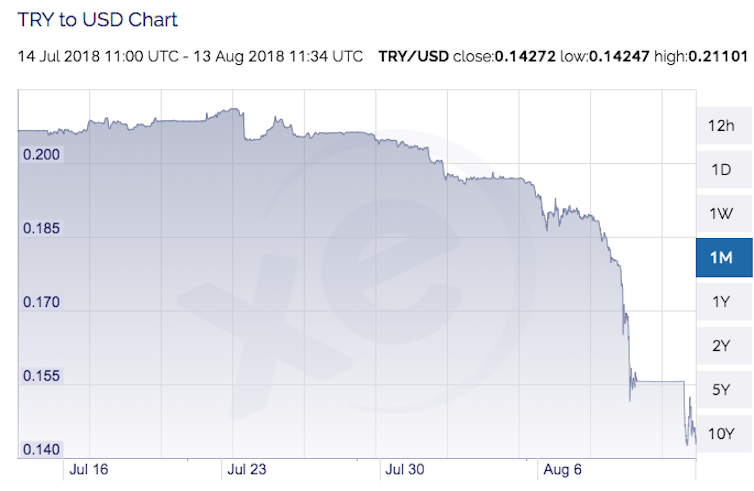
Global markets are on edge once again, this time thanks to the Turkish lira. It crashed more than 15% against the US dollar, euro and pound sterling on August 10 and continued to fall when markets reopened after the weekend on August 13.

The latest trigger was Donald Trump’s announcement that he would double import tariffs on Turkish steel and aluminium. But the lira has been falling consistently over the past year as markets fear for the president’s increasing control over the economy.


With their mammoth depth and reach, global currency markets reflect big shifts to new economic and political realities. Sterling dropped by more than 10% when it became clear that the UK had voted to leave the EU in June 2016. Currency markets can also hasten these shifts, for example in 1992 when the UK crashed out of Europe’s fixed currency regime, the Exchange Rate Mechanism, after sustained runs on sterling in currency markets.

The lira crisis therefore – at the very least – reflects the political and economic turmoil taking place in Turkey. It could also play a key role in shifting the country from relying on the West to aid its economic development and turning east to Russia and China for growth and investment.

Crisis and contagion


The underlying economic cause for the crisis is simply a lack of confidence in Turkey’s economy. Inflation is spiralling (currently more than 15%), Turkish companies are saddled with foreign debt and the country has one of the world’s largest current account deficits in proportion to its economic output, heightening fears of a debt crisis.

As an open economy since the late 1980s, Turkey has attracted significant international capital flows. These flows, some of which are highly mobile and short term, also expose Turkey to sudden stops and reversals when international investors fear the worst. The recent history of globalisation in developing countries is full of such crises, including the 2000-01 Turkish banking and currency crisis. It was the aftermath of that crisis that brought Recep Tayyip Erdoğan and his AK party to power.

As of August 2018, Turkey has an external debt of US$406 billion, US$99 billion of which is short term. What worries foreign banks and markets is the exposure of some European banks, as direct investors in the Turkish banking sector. According to estimates, this amounts to more than US$138 billion.


              Turkish lira to the US dollar.
              xe.com


Should private Turkish debtors, who owe around 75% of Turkey’s external debt, fail to service their share as a result of the nosediving lira and creditors’ unwillingness to lend any more hard currency, the European financial system might have to absorb significant losses. This is similar to what happened during the Greek debt crisis.

Political decisions


None of these debt figures have emerged overnight. What transforms them into a currency and debt crisis is ultimately political. The presidential election in June gave Erdoğan unprecedented control over all branches of the state and he has made his intention to interfere with the economy clear.

Since the new presidential system came into effect, international investors have been trying to understand where Erdoğan would steer the Turkish economy. The signals so far, including Erdoğan’s appointment of his son-in-law as the minister in charge of the economy, suggest a new period of “Erdoğanomics”. This includes a mix of high government spending, politically repressed interest rates and runaway inflation. Such a heady mix has caused a surge in Turkey’s risk premium.

The worsening political relationship between Turkey and the US does not help. Over his 16-year rule, Erdoğan has rallied his supporters on a number of occasions against real and purported threats to his rule. He is once again  defiant against Western economic and political actors, whom he accuses of striving to destabilise Turkey under his rule, this time via the runs on the Turkish lira. 


The Conversation


This defiance seems to have consolidated Erdoğan’s domestic power, but given the country’s considerable economic reliance on Western banks and markets, the country is now more vulnerable than ever to a currency and debt crisis of its own making. Freeing Turkey from this difficult corner will be a feat. If and when Erdoğan achieves it, Turkey will probably have shifted a considerable part of its economic and political allegiances, from the West to the East, with both Russia and China potential future allies in what Erdoğan has called an “economic war”.

Emre Tarim, Lecturer in Behavioural Sciences, Lancaster University

This article was originally published on The Conversation. Read the original article.

Friday, 5 January 2018

Searching for the futures of consumption


On the 6th of May, 2017, Lancaster University in the northwest of England, where I have been working as a lecturer in the Department of Marketing since September 2016, held a Community Day for the city of Lancaster community. The premise behind this event was to showcase to the public in an interactive way what the University is doing in research, teaching and community engagement. There were several dozen activities, such as making of custard rockets, 3D printing, theatre plays, and robo-car racing.

Some high chemistry during Lancaster Community Day (By Lancaster University)

I, Ronika Chakrabarti, Stefanos Mouzas, Anuja Pradhan, and Mohammed Chaded from the Department of Marketing designed and led our concept of Marketing Pavilion to showcase to the public what Marketing is and what the Department has been doing in research, teaching and public engagement. To be honest, this whole effort helped me understand Marketing better as an academic discipline and see Marketing's close connections with social science and human science disciplines such as Sociology and Psychology.
Marketing Pavilion Flyer (By Emre Tarim)

One of the activities at the Pavilion was what I called a "search" - namely, a group of people coming together in a total horizontal way (no hierarchies or status distinctions- e.g., researcher, student, member of public) and discussing a topic and searching its future with a view to taking action for that future.

I learned this method when I was working as a consultant at Arama Search Company, Istanbul, Turkey in 2012 and 2013. This company is founded by Oguz Baburoglu who is an internationally renowned action researcher. Having learned some aspects of the craft under Oguz's wings, I thought it would be interesting to apply this method during the Community Day.

At the end, we had an hour-long search for the futures of consumption, and we concluded with the necessity of universal design principles for best practices in production and consumption. Below is a step by step account of how we searched for the futures of consumption and came up with this conclusion.

Our search session aimed at exploring what we understand from consumption, and how we see its future and how we would like to see its futures. Our aim was therefore two-fold- namely, elaborating the consumption related trends that we see and experience, and articulating the futures of consumption that we as a community would like to see

Our search method consisted of simply asking questions and writing down answers on whiteboards and flip charts with a view to collectively identifying commonalities in our answers, and collectively moving on to the next question and theme on the basis of those commonalities.

Emre and Stefanos recording the ideas on whiteboards (by Anuja Pradhan)
We started with the question – What is consumption? This surely created a good number of answers in the form of key words that came to our minds. In the process, we also realized that we were dwelling more on the negative aspects of consumption, and some of us reminded the positives of consumption, such as the scientific advances, that made our lives safer, healthier and longer. As we were reaching saturation in our definitions - key words, we turned our attention to changing forms of ownership in consumption in digital age, and the often overlooked materiality of consumption (e.g., production, transport etc.), including the waste it generates

Discussing the definitions of consumption (by Anuja Pradhan) 

Consumption: Definitions – Key words 
Buying 
Need for something, satisfying needs
Convenience
Desire
Entertainment
Resources
Supply and demand
Fashion (in trends, modes of consumption)
Ethics
Advertising
Tiredness (caused by information/product overload, never ending “needs”)
Scientific advances and positive outcomes generated with consumption
Senses of consumption (simplicity vs sophistication)
Ownership (consumption access and sharing)
Addiction
Finite resources - End of consumption?
Materiality of consumption – Waste

Some of the definitions recorded on whiteboards and flipcharts (by Emre Tarim) 

Commonalities : Towards Themes
Themes emerging (by Anuja Pradhan) 

Having listed all the key words, we then searched for commonalities among these definitions and came up with the following four themes:
  • Materiality
  • Information
  • Consumer needs vs. Consumer wants
  • Consumption, Wealth and Prosperity

Futures of Consumption?

Continuing with the positive outcomes of consumption and how to sustain them in the future, we decided to focus on the last theme- namely, Consumption, Wealth and Prosperity. Our question was how consumption, despite all the negatives (e.g., waste, addiction, inequality, etc.) it generates can generate wealth and prosperity for all , not the few (no political slogan intended here!). After this decision on our collective focus, we searched for ways in which consumption can achieve this.

Ideas flowing on futures of consumption (by Anuja Pradhan) 

Here are the points and questions raised:
  • Inclusion, Inclusive consumption 
  • Is consumption becoming more inclusive or exclusive ? (e.g., How can we make sense of foodbanks, something as an inclusion or exclusion move? Is it something positive – “allowing people to continue consuming”, or negative- “justifying and/or concealing policies and inequalities that condemn people to food banks?”) 
  • Which unit and level of consumption should we focus on when we think of inclusion and exclusion? (E.g., individual, family, citywide, nationwide) 
  • What is the purpose of the consumption item? (Our consumption needs, are they active or latent? ) 

As we continued with the inclusion and inclusive consumption search, we came up with the following question: How can we make products and consumption more inclusive?

We also realized that this also touched on the materiality of consumption- namely, design, production, and so on. We therefore focussed on what kind of products (designs) we need to bring about the futures that we would like to see consumption generate. 

Products (Designs)
Product design principles ? (By Anuja Pradhan) 

  • Multifaceted in purpose (e.g., Meeting individual consumption and societal needs at the same time)
  • Built to last, given the finite environmental resources? What about wealth and prosperity from continuous production? A need for balance between sustainable production and sustained prosperity 
We then decided to write down some design principles for future products:
  • Add-ons (Making products multifaceted in purpose) 
  • Sustainable (Durability, ecology, transparency [e.g., plastic microbeads in personal hygiene products and campaigns to ban them ], intergenerational responsibility) 

The Future of Consumer Activism

Having discussed these, we realized that we as consumers have a great role to play in shaping product designs and  in morphing products, producers and markets towards the inclusive futures that we desire. This brought us to the matter of consumer activism. Here are some of the themes that arose from our discussion on the future of consumer activism
  • What does a durable/sustainable product look like? (E.g., a cleaning mop lasting 10 years?) 
  • How can we communicate our product design desires to producers? 
    • Digital democracy [enabling us to work with producers?] 

Futures of consumption (By Anuja Pradhan) 
We then discussed aspects that are closer to us consumers in consumption and consumer activism such as vulnerabilities, emotions, traditions, and how we can come up with best practices among ourselves and producers.
  • Minimizing vulnerability (as consumers)? 
  • Best practices in ? (Cost and affordability and price, waste and sustainability, institutions [existing practices vs how to institutionalize rare but best practices]) 
  • Guilt [associated with consumption, production, waste] 
  • Consumer protection- What should be its scope? 
  • Mobilizing emotions [associated with consumption/issues] 
  • Family traditions [in consumption] vs Change (What is the unit of change in behaviour [individual vs. family?]) 

Future Actions and Challenges
Points about future actions 
and challenges (By Anuja Pradhan)
We then considered necessary steps in bringing about changes for the futures we desired. In doing so, we also acknowledged the contradictory nature of issues in consumer activism, e.g., Lack of information vs. Information overload; Yes, mobilization but how?; Have information but what is next?; Institutions vs. How to institutionalize the new design needs for a different future. Here are the points we recorded on flipcharts
  • Seeking information to inform people (but information overload too, is this necessarily a bad thing?) 
  • Mobilization [of consumers and other stakeholders but how?] 
  • Crowdsourcing [information and other resources necessary for mobilization in a digital age?] 
  • Institutions (redesigning e.g., family, corporations, market, the state] But can all expectations be included? 
Universal Design Principles
Result of an hour-long search? (By Emre Tarim) 
Having discussed for an hour the meanings and futures of consumption, we wrapped up the search brainstorm with two practical outcomes or challenges that we consumers can pursue for a future of consumption that generates inclusive and sustainable wealth and prosperity:
  1. Universal (consumption and product) design principles for best practices [towards inclusive and sustainable wealth and prosperity]
  2. [Answering the following questions] 
    1. How will [these principles] look like ?
    2. Who will do [formulate] [these principles]?

We felt that these questions should be answered by searches like the one we had during the Community Day at the Marketing Pavilion. The issue of consumption is too important to be left only to producers.

Many thanks to all participants at the Marketing Pavilion

Sunday, 5 February 2017

What lies ahead for Istanbul as an international financial centre?

Levent, one of Istanbul's financial districts. By VikiPicture  [CC BY-SA 4.0 (http://creativecommons.org/licenses/by-sa/4.0)], via Wikimedia Commons


I have recently published a short commentary on the phenomenon of international financial centres- public and private initiatives to promote  major global cities as hubs of financial trading and services. Having explained the background to the concept and how cities are ranked by international business consultants, I have then discussed Istanbul's very own initiative led by the AKP government since 2007.

The initiative's list of objectives is long and consists of  areas ranging from education through infrastructure to regulation. These objectives are comprehensive and commendable as they will expand and deepen Istanbul's sophisticated financial services to Turkey and its hinterland.  Yet, as I have  noted in my commentary,  one of the two most prolific activities  for the Istanbul finance centre initiative has so far been construction work in Atasehir - a densely built and congested area in Istanbul's Asian side. This several billion dollar building work aims  to relocate various state financial institutions from Ankara to Istanbul, and complement these office buildings  with a shopping mall, residential buildings and recreational areas. The ongoing building work  does not make much sense given the advances in telecommunication technologies and the fact that these state institutions do not seem to suffer from poor infrastructure or building stock. It can however be understood as part of the AKP policy of promoting economic growth via construction and infrastructure  activity, especially at a time when the Turkish economy has been stagnant compared to its growth potential as an emerging market.

Atasehir district, where the building work for Istanbul finance initiative takes place. By © Nevit Dilmen, CC BY-SA 3.0, https://commons.wikimedia.org/w/index.php?curid=19848353 


Second most prolific activity seems to be promoting Islamic finance. Islamic financial services have made significant advances in recent decades and several cities such as Kuala Lumpur, London and Doha compete for a larger share in this fast growing sector. Islamic finance is not just for pious Muslims. It can be attractive to ethical investors and any other investor when it offers competitive financing options.

Istanbul's competitiveness in Islamic finance has a lot to improve as currently there are only few Islamic banks in Turkey and there is no regulatory authority that can check the Sharia compliance of any existing or future financial product or service. Reliance on an external authority such as one  in London or Egypt might be complicated and reduce Istanbul's competitiveness.  All in all, the focus on Islamic finance has the potential encourage many pious Turkish savers to shift to their savings - which they generally keep in instruments such as gold, foreign currency, and real estate-   to the Turkish financial system. It can also be attractive to regional and international investors. Nevertheless, the initiatives for Islamic finance in Turkey should not be designed as a substitute for the existing financial services and markets, which are premised on secular commercial and judicial principles. After all it is these services that have put Istanbul on the global map of financial centres. Narrowing their reach by promoting Islamic finance at their expense will not help Istanbul nor the Turkish economy.

Here is the link to the article in The Conversation - a great platform for academics to disseminate their research and opinions with journalistic flair . Articles are free to republish with attribution under CC licenses. Many thanks to  Annabel Bligh for her excellent editorial support 

Thursday, 13 October 2016

Studying financial markets: Methodologies, disciplinary boundaries or What it takes for a social scientist to get the Nobel?

As part of PhD programme at Edinburgh University Sociology, we the PhD students were encouraged to write working papers on our PhD topics. I wrote a piece on the methodological issues and boundaries in research on financial markets. This was then published in Edinburgh Working Papers. The paper was a very limited survey of the respective literatures of mainstream finance, behavioural finance, international political economy, economic sociology, and social studies of finance (SSF). The latter is simply the application of social science disciplines [not financial economics or behavioural finance!] to the study of financial markets and has its origins in the beginning of this century. Despite its narrow scope, I think the paper gave a good flavor to a general audience of how each discipline theorized and approached behaviours and outcomes in financial markets and what was distinctive about SSF as an umbrella approach- namely its focus on materiality (e.g., financial models, market structure)  in individual and collective financial behaviour. In writing the paper, it was also interesting to see how different disciplines, despite lack of any meaningful mutual awareness, shared similar starting assumptions such as rationality and lack of it!

Having looked back, I am not surprised to see that I as a student of sociology devoted a good part of the paper to economic sociology and SSF with a prophecy that SSF would come to occupy a bigger role in our understanding of financial behaviour. Almost a decade later,  I think that prophecy has materialized so to speak with numerous articles, manuscripts and edited books that are inspired by essential theories and concepts from the SSF's pioneering works (e.g., Callon, MacKenzie and Millo). This is not surprising as SSF's conceptual and theoretical corpus is not unfamiliar and undecipherable to researchers from different subject fields such as anthropology, sociology, and organisation studies. Compare that to mainstream and behavioural finance, which in their empirical manifestations are in a constant debate as to whether markets are efficient or not, using large price data and elegant mathematical modelling to detect (in)efficiencies within. The accessibility of SSF and its attention to the material world that surrounds our behaviour also motivate social scientists to explore how theoretical and material artefacts come to underpin and transform our behaviour not just in financial but also other business domains such as production and marketing.

The lack of an overarching theory such as efficient markets/random walks and prospect theory/ heuristics and biases can be seen as a weakness in economic sociology's and SSF's approaches to financial markets. Although performativity- the theory that economics as a science and its theoretical corpus can format real life markets with a good deal of institutional work-  has engendered a great deal of studies in economic and financial domains (see for example the latest book on performativity, and an earlier special issue on the concept), it is not the only theory that informs SSF's ongoing interest in financial domain. This is a perhaps a strength and a weakness for the future of SSF. On the one hand, being interdisciplinary in its theoretical and conceptual toolkit allows SSF to demonstrate how materiality of markets  is enmeshed with politics, culture and networks. In this vein, one can observe the proliferation of SSF originated  theories, concepts and puzzles within international political economy, anthropology, and accounting research and vice versa.  All these not only encourage interdisciplinarity among social science but also enrich our understanding of financial behaviour. On the other hand, the lack of an overarching falsifiable  theory that attempts to explain individuals and markets behaviour within SSF and economic sociology or any other social science field still underpins in my view  mainstream and behavioural finance's lack of interest in SSF and social science research. Overall, there is hardly any reference in mainstream and behavioural accounts on financial behavior to any pioneering and novel work from SSF and the social science disciplines it brings together. On the other hand, SSF researchers engage with mainstream and behavioural finance. Yet, this engagement mostly takes the form of theoretical/conceptual critique with few insightful  empirical  challenges.

Having thought all these, two questions come to my mind.

What would the mainstream and behavioural finance literature look like  if SSF researchers (antropologists, sociologists, organisational researchers) were retrained as mainstream or behavioural researchers on financial markets?

What would it take for a SSF researcher to get the Nobel prize in economics ?